Solon is grateful for the opportunity to teach and learn from his students. He currently teaches full time as a core faculty member at Princeton University, jointly between the Lewis Center for the Arts Program in Theater & Music Theater and Department of Music. Below are some of his recent course offerings.
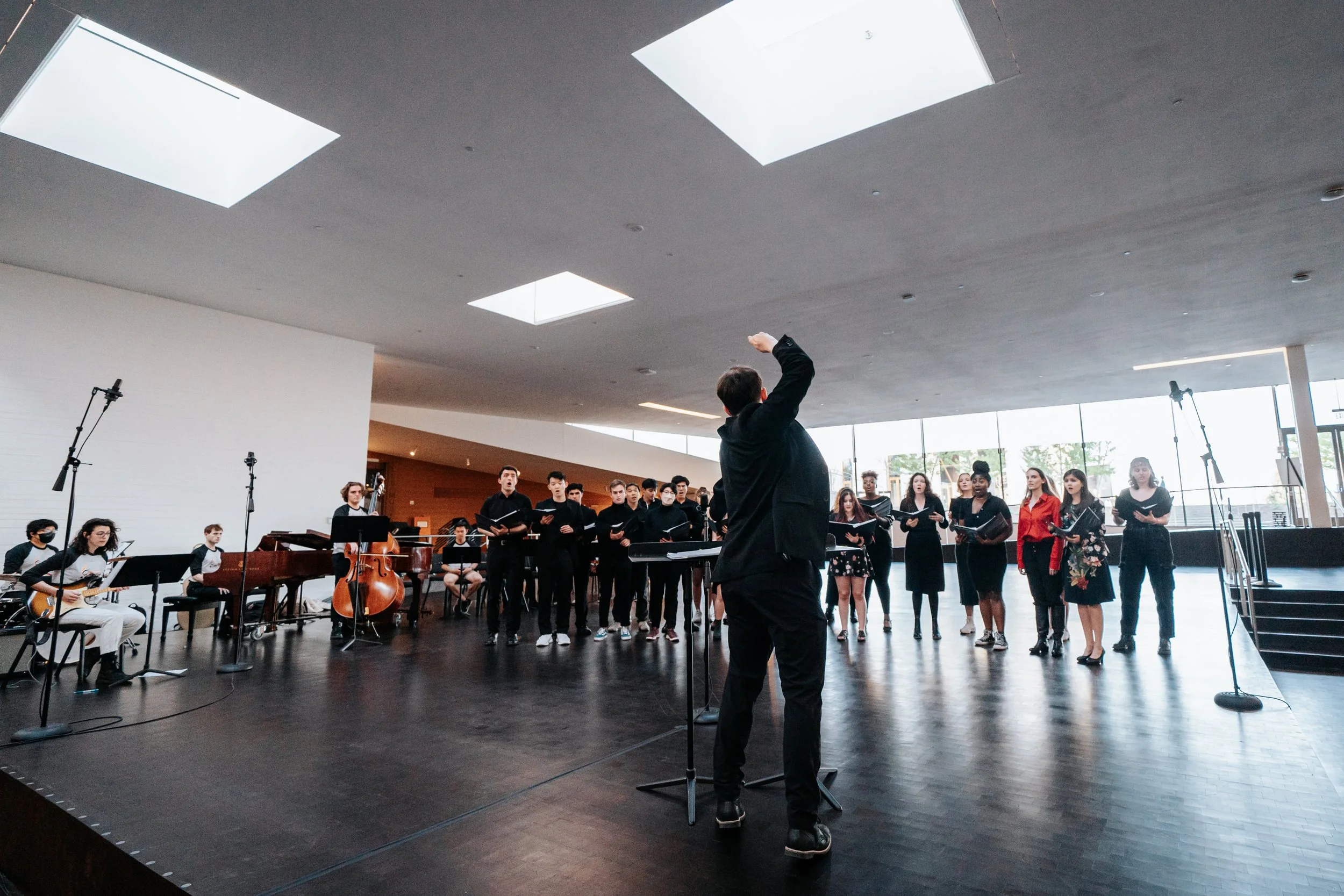
MTD/MUS 404: Creative Musical Leadership (Spring 2023, Spring 2025)
Course Description:
In this course, students will develop and implement a personal philosophy of music ensemble direction. Students will connect practice-based learning with broader theories of art-making, exploring questions about why, how, and with whom people make music. For those who dream of directing a vocal group, conducting an orchestra, music directing a musical, or even inventing a new ensemble, this process-driven course will create an environment for experimentation, risk-taking, and musical and personal growth. A background playing an instrument, singing, conducting, or composing music is required.
Course Page: https://arts.princeton.edu/courses/creative-musical-leadership-sp-25/
Student feedback:
“Of all the music classes I’ve taken at Princeton, this one has definitely been one of the most educational, fun, and interactive. I found myself being pushed out of my comfort zone and challenged to expand my musicianship in new ways.”
“I feel like I’ve learned so much about myself over the course of the semester. I feel like I’m more in tune with the reasons I enjoy music and teaching music, my own personal philosophies of music-making, the things I’m surprisingly good at, and the things I’m unsurprisingly bad at. I’ll be taking several learnings from this class into my future as a creative and a leader.”
“I’d like to thank Solon for inspiring me to think about the purpose of a musical leader, to take risks, to engage with physical space, and to consider the theatre world as a possible future career.”
“[Solon] created a supportive atmosphere that encouraged active involvement from all students. They valued our opinions and actively sought our input, thus fostering a sense of collaboration and shared learning. Additionally, the instructor responded attentively to questions, opinions, and criticisms from students. They provided insightful feedback, addressed concerns, and encouraged respectful dialogue.”
“The seminar was deeply stimulating intellectually and musically. The space created for discourse, musical experimentation, and learning was absolutely fantastic. The environment fostered by the seminar was deeply fertile for musical growth and musical connection.”
“I really enjoyed [preparing] a work to rehearse with the class. These classes really pushed my conducting technique and rehearsal strategies, and allowed me to grow quickly.”
“Solon is great and offers very helpful feedback! Highly recommend this course if you have a pretty strong background in music and genuinely care about developing these skills.”
“Super great course. Definitely what you make of it, but if you come in with the attitude to improve, you'll have a great time and get a lot of great experience. Solon is a fantastic mentor.”
“TAKE THIS COURSE! Solon is amazing, very understanding, and a genuinely kind professor to learn from. Don't let the work build up at the last minute from the week and come to class having done all the readings, arrangements, and preparation. This is a very cool hands–on course and one of my favorites at Princeton.”
“Overall, the course has been incredibly instructive for me as a musical leader (and as a musician in general, actually)… I am grateful to have been inspired by so many amazing musicians and leaders throughout the semester, and to have had the space and guidance to deeply question the philosophies and reasoning for art-making. I hope to use all this fuel for my own musical journey moving forward, and I am very excited for it.”
“I’m so glad and grateful that I took this class. Being able to conduct an original tango arrangement with professional musicians was an incredibly fulfilling experience even if it only lasted eight minutes. I learned about various styles of rehearsal direction and conducting (who knew I’d end up conducting The Firebird?), and I feel far more qualified and prepared to music direct after taking this class.”
“I think more than anything, this course gave me a glimpse into how multifaceted a musical leader must be: they are simultaneously an enforcer (correcting notes in a constructive way), an informer (providing information and context for the music), and an educator (teaching and growing with the ensemble), and most importantly, an observer of the group and themselves.”
“This class has been one of the most useful and genuinely interesting classes I’ve had at Princeton, and it’s probably the class that’s the most aligned with what I intend to do in the future, too. I’m very glad I had the opportunity to take it, and I look forward to applying everything I’ve learned in this class (and building onto it as I go) to my future life as a musical leader!”
“This semester has confirmed that ensemble leadership isn’t just about guiding musicians through a piece of music. It’s about staying open to growth, and learning how to inspire collaboration even when challenges arise.”
“Since the beginning of the semester, I have been much more open to experimentation as a musical leader. My prior training was primarily focused on leading international orchestras who did not speak English and emphasized precision, minimal movement, minimal verbal communication with musicians, and a demand for excellence from before the rehearsal began. However, when working with sight-reading English speakers in a small group setting, those methodologies are not so fruitful. Instead, I have been trying to lead my rehearsals first and foremost with humor and a lighthearted energy while remaining serious about the quality of the final product. That balance has been difficult to achieve, but I think especially for the final projects, I achieved it.”
“At the start of the semester, I had a very unrefined skill set because the majority of my musical leadership experience originated outside of the classroom. Due to these circumstances, I found myself struggling with some of the basic aspects of being a conductor, despite my past conducting experience. Throughout the duration of this course, I’ve focused on hand independence and while I still slip into bad habits, my attentiveness to cues and the support musicians need has improved. I also believe that I have a better understanding of my role as a musical leader for instrumentalists and pit musicians. I was very intimidated by orchestral music and the idea of arranging for instrumentalists, but trial and error accompanied by feedback from my peers has helped me get over this hurdle. In addition to my growth compositionally, I also believe I have an increased awareness of what I need to do as a musical leader when working with instrumentalists which will help me as I work on these skills in the future.”
“I think that since the beginning of the semester, I have improved as a musical leader in several ways. For one thing, I have become a more skillful conductor and gained knowledge such as how to properly prepare a score, how best to cue musicians, and how to incorporate my left hand into my conducting. I feel that my conducting is overall clearer and that I am more prepared to lead rehearsals and performances of challenging music. I have also grown more intentional about many aspects of my rehearsal process. For instance, I believe that in comparison to the start of the semester, I am now doing a better job of framing my rehearsals, getting everyone on the same page about our overarching goals before diving into the nitty gritty of the music. I am more confident as a musical leader in many respects as well: I feel much more self-assured, as an example, working with instrumentalists rather than just singers. This was a skill that I had not exercised much before taking this class, and I am glad to have pushed myself in this way.”
“Since the beginning of the semester, I’ve become much more confident about my ability to lead an ensemble. I think this growth has stemmed from two realizations—first, that the most important thing is to focus on the immediacy of communication between me and the musicians via the music. Preparation is key, but there is no replacement for in-the-moment togetherness. The second is that the most helpful thing I can do for an ensemble, as we talked about in the first conducting session, is to lean into the things I am best at in order to make those things the cornerstones of that interpretation. Things like diction, rhythm, vocal color and technique, blend, and work with lyrics have all come more naturally to me this term than some other aspects of music with which I have had less contact. I didn’t try to be super involved in the technical aspects of how [STUDENT 1] was approaching the color of his sound, or how [STUDENT 2] was voicing his chords. This kind of very intentional selectivity has helped me achieve in our rehearsal processes—my manner in these recordings is much more relaxed than earlier in the semester. I feel like I can make a real difference in the ensemble without accounting for every aspect of the performance myself, which has been a real shift in approach.
It has also taught me that leading rehearsals—which I for a long time viewed as a real source of stress, and sometimes a burden—can be really fun when approached the right way. The relationships I have created with the musicians with whom we’ve worked feel valuable, and the feeling when I’m in the flow of a piece can be really joyful. In some ways, it’s similar to the feeling of being a musician in a choir or band, in the sense that you get swept up in the music. The difference seems to be in the broadness of experience one has as a conductor. I have the rare opportunity to somehow be part of the music making for instruments that I do not possess the skill to play. I get to help shape an oboe line, or intensify a phrase of contrabass music, when I could not do so as a musician. The tradeoff is, obviously, you have to know and account for everyone’s part, and everyone’s role, for every piece. The work of conducting, this course has made clear to me, is immense.”
MTD 217/MUS 217: The Musical — Past, Present, and Future
What is a musical and why should we care? As performers, writers, designers, theater fanatics, or simply pop culture consumers, we are touched by musicals every day. Reaching millions of people, this uniquely collaborative and expansive form continuously shapes our world. Students will explore the history of the American musical and develop tools to analyze musicals and their reception. They will investigate music theater through artist conversations, trips to see musicals, and expanding scholarship in the field. The class will culminate with visions of the future of the musical presented via student-written, collaborative mini-musicals.
Course Page: https://arts.princeton.edu/courses/the-musical-past-present-and-future/
Student Feedback:
“One of my favorite courses I have taken at Princeton! Take it if you have any interest in musical theater. I came into the class with background in music but not a lot of theater experience, and I still found the course to be very accessible. Some music and/or theater experience, while not officially a prerequisite, will be very helpful. I come away from this class with a much deeper appreciation for the Broadway musical. Solon is wonderful, and he posed so many challenging questions that pushed me to think deeply about musicals in a way that I never had before. Of course, there are probably going to be people in the class who know a TON about musicals, and you might not, and that's ok. Take it as an opportunity to learn from each other. We had the opportunity to get free tickets to two Broadway shows, so that was a definite plus. Finally, don't take this assuming it will be an easy class! It was a fun class and a very rewarding class, but it was also a lot of work from week to week.”
“Take this course if you can! It was by far my favorite course. The weekly assignments are normally some readings, a brief response, and a listening journal. Solon is amazing and always makes sure to keep the class engaging through discussions and activities. We had some really amazing opportunities, like going to Broadway and talking to Winnie Holtzman, the writer of Wicked. Aside from learning the fascinating history of musical theater, we also got to try our hand at making our own mini–musicals. The entire experience was so fun!
“Super fun class! Fun to think about a form of media that I don't normally think about as much. There's consistent work and reading, but the readings and work is all pretty fun and light.”
“This is a great course! The readings are a bit longer than you would expect for a MTD course, but they are all fascinating. Solon is AMAZING!”
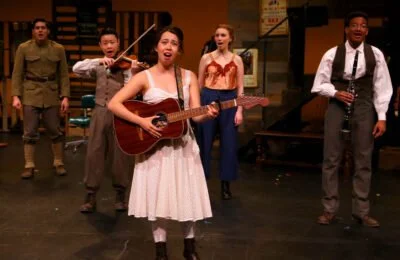
MTD 307/THR 307/MUS 311: Revivals, Revisals, and Reimaginings of the Broadway Musical [coming Spring 2026, co-taught with Professor Stacy Wolf]
The most frequently produced musicals are revivals. On Broadway, at universities, at high schools, community theatres, and summer camps, most shows that are performed have been performed before. As musical theater scholars, how do we think about, research, analyze, and interpret revivals? As musical theater artists, how do we navigate revivals and the history of a show? In this seminar, we’ll explore the scholarship and the practice of musicals’ afterlives, discussing theories of revivals and examining and re-conceptualizing shows. Aspiring directors, music directors, designers, and performers can put your ideas about revivals into practice.
Course Page: https://arts.princeton.edu/courses/revivals-revisals-reimaginings-broadway-musical-sp-26/
Student Feedback: